

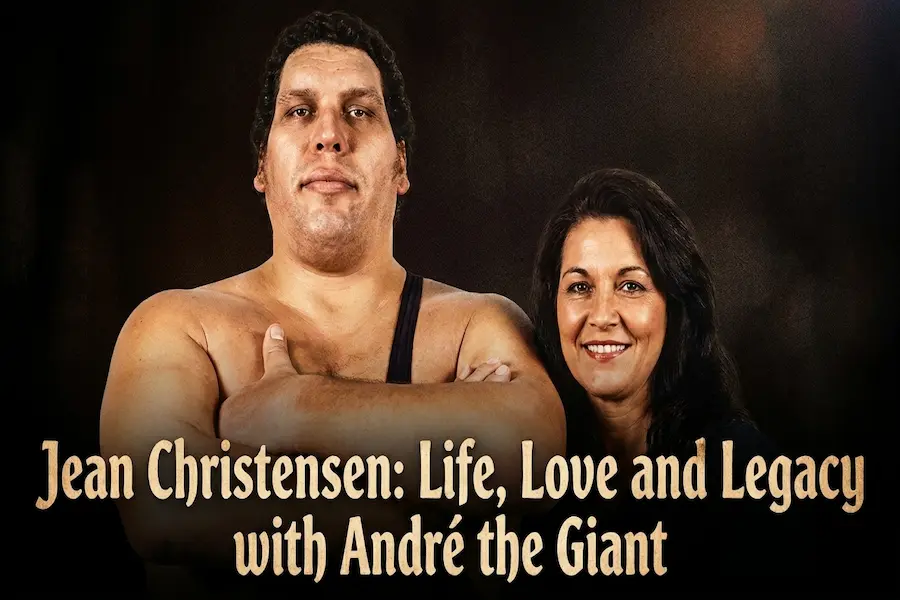
Jean Christensen lived one of wrestling’s most fascinating untold stories. Born in Minnesota on August 15, 1949, she started as a fashion model before becoming a groundbreaking public relations professional in World Wrestling Federation during the 1970s. Most people know her as André the Giant’s partner and the mother of Robin Christensen Roussimoff but her life story goes far deeper than that single relationship.
Jean navigated a male-dominated wrestling industry, raised a daughter mostly alone while her partner traveled 300 days a year, and helped professionalize how wrestling handled media long before it became the entertainment empire we know today. She stood 5 feet 7 inches tall with Danish-American heritage, brought sharp intelligence to everything she did, and chose independence over easy answers every single day of her adult life.
This complete biography answers every question with verified facts, clears up common confusions (like mixing her up with Attack on Titan’s Jean Kirstein or other people named Christensen), and tells the full story of a woman whose strength, professionalism, and quiet dignity deserve recognition beyond being remembered as just “that wrestler’s girlfriend.
Quick Facts
| Detail | Information |
| Full Name | Jean Christensen |
| Also Called | Jean Christensen-Roussimoff (unofficial) |
| Born | August 15, 1949, Minnesota, USA |
| Died | 2008 (age 59) |
| Still Alive? | No – passed away in 2008 |
| Height | 5’7″ (170 cm) – NOT 6’4″ as some claim |
| Heritage | Danish-American |
| Careers | Model (1970s), WWE/WWF PR Professional |
| Partner | André René Roussimoff (André the Giant) |
| Married? | No – never legally married |
| Children | Robin Christensen-Roussimoff (born 1979) |
| Net Worth | $100,000-$200,000 (estimated) |
Who Was Jean Christensen?
Jean Christensen was André the Giant’s long-term partner, a professional model, and one of World Wrestling Federation’s first female public relations representatives during the 1970s wrestling boom.
She wasn’t André’s wife legally they never married in the United States despite what many articles claim. She was his committed partner who chose to stay with him despite his brutal travel schedule and the unique challenges of loving someone with acromegaly (the gigantism condition that made André famous but destroyed his health).
Jean gave birth to their only child, Robin Christensen Roussimoff, in 1979. She raised Robin mostly as a single mother while André wrestled around the world. She managed media attention protected her daughter’s privacy and built a career independent of André’s fame.
Important clarity for searchers: Jean Christensen is NOT still alive. She passed away in 2008 at age 59. She is also not the same person as Jean Kirstein from the anime Attack on Titan not related to Danish-Canadian actor Hayden Christensen, and not Linda Christensen or any other person with a similar name.
Early Life and Danish American Heritage
Jean Christensen came into the world on August 15, 1949, in Minnesota during the post-war baby boom. Her family carried strong Danish roots – her parents had emigrated from Denmark before she was born, and Danish culture shaped her childhood home in ways that stuck with her throughout life.
Growing up in 1950s Minnesota as a Danish American kid meant Jean experienced a blend of Old World values and American opportunity. Her parents emphasized education, hard work and independence. They taught her that women could pursue careers, make their own money, and choose their own paths ideas that weren’t universal in that era.
Jean showed early interest in fashion and entertainment. By high school, she stood noticeably tall for a woman of her generation. Where other tall girls in the 1960s might have felt self-conscious, Jean owned her height. She carried herself with confidence that caught people’s attention.
After graduating from a Minnesota high school in the late 1960s, Jean made a gutsy choice. Instead of taking a traditional secretarial job or getting married young like many women her age, she pursued modeling. This meant moving to bigger cities, competing for work, and building professional connections in an industry that could be brutal to newcomers.
Her Danish heritage gave her striking features – high cheekbones, natural elegance, and a presence that cameras loved. Her Midwestern work ethic gave her reliability that agencies valued. Jean wasn’t the most famous model of her era, but she worked steadily through the early 1970s.
Jean Christensen’s Professional Modeling Career
In the early 1970s fashion world, Jean Christensen built a respectable modeling portfolio doing commercial work and print advertisements.
She wasn’t walking runways in Paris or appearing in Vogue. Her modeling career focused on:
- Department store catalog shoots
- Local fashion shows in Minneapolis and nearby cities
- Commercial photography for regional brands
- Promotional modeling at business events
- Print advertisements in newspapers and magazines
At 5 feet 7 inches tall, Jean hit the sweet spot for commercial modeling. She was tall enough to showcase clothing well but not so tall that she intimidated average-sized consumers looking at ads. Some online sources incorrectly claim Jean stood 6’4″ this is completely false and appears to be confusion with André’s height or simple internet error.
What modeling taught Jean proved more valuable than the paychecks:
Professional skills she developed:
- How to present herself confidently in any situation
- Understanding what cameras capture and what they miss
- Reading a room and adjusting her approach
- Managing professional relationships with photographers, clients, and agencies
- Handling rejection without taking it personally
- Building a network in entertainment industries
Business lessons she learned:
- Negotiating contracts and payment terms
- Managing her own schedule and bookings
- Marketing herself to potential clients
- Understanding media and publicity value
- Balancing professional image with personal privacy
By the mid-1970s, Jean was ready for something more challenging than modeling. The entertainment business fascinated her, but she wanted to work behind the scenes where the real power and longevity existed. That’s when she discovered an opening in sports entertainment public relations – specifically with World Wrestling Federation, the company that would later become WWE.
How Jean Christensen Met André the Giant

The meeting that changed Jean Christensen’s life happened sometime between 1972 and 1974 – sources conflict on the exact year, but everyone agrees it was the mid-1970s when Jean worked for WWF’s public relations department.
Her job wasn’t glamorous. She coordinated:
- Media interviews for wrestlers before big matches
- Press conferences to promote upcoming events
- Photographer access for wrestling magazines
- Radio and TV appearances for top stars
- Fan events and autograph signings
André René Roussimoff already famous as André the Giant was WWF’s biggest draw. At 7 feet 4 inches and over 500 pounds, he was literally the largest attraction in professional wrestling. Managing André’s media presence meant managing constant curiosity, invasive questions, and people who saw him as a spectacle rather than a person.
Jean approached André differently than most people in the wrestling business. She didn’t gawk at his size. She didn’t ask stupid questions like “how’s the weather up there?” She didn’t treat him like a circus attraction. She spoke to him like a professional colleague, discussed logistics efficiently, and gave him the same respect she’d give any other wrestler.
This approach was shockingly rare for André. Most people couldn’t see past his physical appearance. Most conversations started and ended with his gigantism. Most relationships felt transactional – people wanted something from the giant.
Jean wanted to do her job well. That’s it. She needed André to show up on time for interviews. She needed him to give good quotes to reporters. She needed him to be professional. She treated him accordingly.
André noticed. After weeks of professional interaction, he started lingering after meetings. He asked Jean questions about her life, her interests, her opinions on wrestling storylines. They discovered shared perspectives:
- Both valued privacy intensely
- Both were pragmatic about the entertainment business
- Both came from working-class backgrounds
- Both disliked fake, superficial relationships
Over months, professional respect became genuine friendship. André trusted Jean in ways he trusted very few people. She saw past the giant to the lonely man underneath. She understood that his size caused constant pain, made simple daily activities nearly impossible, and condemned him to a life of isolation unless he could find someone who saw him as human.
Romance developed slowly and naturally.They talked for hours about life, family, dreams, and fears. They fell in love not because of external circumstances but because they genuinely enjoyed each other’s company and trusted each other completely.
The Unconventional Relationship: Partners Not Spouses
Search for “andre the giant wife” or “andre the giant’s wife” online and you’ll find dozens of articles calling Jean Christensen exactly that. Technically, this is wrong.
The truth about their relationship status:
They were committed life partners who lived together when André wasn’t traveling. They considered themselves in a permanent relationship. They had a child together. They shared finances and made major life decisions together. But they never signed a marriage license or had a legal wedding ceremony recognized by US law.
Some sources mention a possible ceremony in Canada, but no marriage certificate has ever been verified. Even if such a ceremony happened, it apparently wasn’t legally filed or recognized.
Why didn’t Jean Christensen and André the Giant marry officially?
Multiple practical and personal reasons:
André’s brutal schedule: He wrestled 300-350 days per year. He crossed continents constantly. He spent more time on airplanes and in hotel rooms than in any home. Traditional marriage seemed pointless when they could barely live in the same place.
Jean’s independence: She had her own career and income. She didn’t need legal marriage for financial security. She valued her autonomy and didn’t feel compelled to fulfill traditional expectations just because society said she should.
Legal complications: André worked internationally. His income came from multiple countries. Marriage would have created tax complications, inheritance issues, and legal tangles across jurisdictions.
Personal preference: Neither Jean nor André felt they needed government paperwork to validate their commitment. Their relationship was real to them legal documentation felt unnecessary.
Privacy protection: Marriage records are public. André and Jean both valued privacy intensely. Not marrying kept their relationship more private than a public marriage would have allowed.
What made their relationship work where many couldn’t:
Mutual respect: Jean didn’t try to change André. André didn’t demand Jean give up her career or identity. They accepted each other fully.
Realistic expectations: Jean knew André’s wrestling career came first financially. André knew Jean needed independence and her own life. They didn’t expect fairy-tale romance – they built a partnership around reality.
Deep trust: André trusted Jean with media strategy, family decisions, and protecting his privacy. Jean trusted André to provide financially and emotionally despite his absence.
Acceptance of limitations: Most people want their partners home every night. Jean accepted that André would be gone most of the year. Most people want traditional milestones. They both accepted their path was different.
Friends who knew them described Jean and André as equals. She didn’t worship him or treat him like a celebrity. He didn’t patronize her or make her feel less important. They operated as partners making joint decisions about their unconventional life together.
The Birth of Robin Christensen Roussimoff
In 1979, Jean Christensen gave birth to Robin Christensen-Roussimoff in France while André was on a European wrestling tour. Robin’s birth changed everything for both parents.
Suddenly André, who had avoided serious relationships for years because of his condition and career, had a daughter. Jean, who had maintained career independence, now had motherhood responsibilities. Their unconventional relationship now included a child who deserved stability.
The paternity situation was complicated initially:
André didn’t immediately acknowledge Robin publicly. Several factors played into this:
- Fear his gigantism condition might affect his daughter
- Concerns about media attention overwhelming a child’s normal life
- Legal and financial questions about international child support
- Wrestling industry pressure to maintain his “single giant” image
Legal discussions occurred. Eventually André accepted paternity, agreed to financial support, and included Robin in his will. But these negotiations took time and caused stress Jean handled while caring for an infant.
Jean’s choice as a mother:
She made a pragmatic but difficult decision. She would raise Robin primarily alone. André would:
- Visit during breaks from wrestling (infrequent but genuine)
- Provide substantial financial child support
- Stay connected through phone calls and letters
- Be Robin’s father in spirit even when physically absent
This arrangement wasn’t what Jean had envisioned for motherhood. But it was realistic given André’s career. Wrestling was André’s livelihood – he couldn’t just quit. His massive size meant few other career options existed. His acromegaly was getting worse, meaning his wrestling years were limited and he needed to earn while he could.
So Jean became essentially a single mother while still in a committed relationship with André. She handled:
- Daily childcare alone
- School decisions and activities
- Medical appointments and emergencies
- Teaching Robin about her father from distance
- Protecting Robin from media curiosity
- Building a normal childhood despite extraordinary circumstances
Robin Christensen Roussimoff today:
Now an adult, Robin has become the keeper of her father’s legacy. She appeared in the acclaimed 2018 HBO documentary “André the Giant,” sharing personal stories about both parents. She consults on wrestling projects, preserves family photos and memories, and speaks publicly about growing up as André the Giant’s daughter.
Robin credits her mother Jean with giving her a stable, loving childhood despite the challenges. In interviews, she describes Jean as strong, protective, and determined to give her daughter normalcy that Jean herself had to sacrifice.
Challenges That Tested Their Bond
Jean Christensen and André the Giant’s relationship faced obstacles most couples never encounter.
The distance problem:
André worked constantly. His schedule demanded:
- 300+ days traveling annually
- Wrestling matches in Japan, Europe, Mexico and across America
- Promotional appearances in dozens of cities
- Late nights driving between towns
- Hotels instead of home
- Phone calls instead of dinners together
Jean spent most nights alone. She made decisions without André’s input. She handled home repairs, bills, and daily life solo while technically having a partner. The loneliness was profound and constant.
The health crisis:
André’s acromegaly wasn’t just about size – it caused horrific pain. His body was literally growing too large for itself. His joints ached constantly. His heart struggled to pump blood through such massive bulk. His spine compressed under his own weight.
Jean watched helplessly as André’s health declined year by year. She couldn’t fix it. Medicine couldn’t reverse it. She could only support him emotionally and hope each tour wasn’t his last.
The media circus:
People were obsessed with André. Everywhere he went, crowds formed. Photographers followed. Reporters asked invasive questions. Strangers demanded autographs, photos, stories.
Jean absorbed much of this overflow. When André was unavailable, media called her. When photographers wanted family photos, they pushed her to convince André. She became a buffer between André’s private life and public curiosity.
The financial complexity:
Despite André’s fame, money management was messy. He earned well but:
- Income came from multiple countries with different tax laws
- Cash payments were common in wrestling, making tracking difficult
- His international travel created accounting headaches
- He wasn’t sophisticated about financial planning
Jean handled household finances, set up proper accounting, and managed the practical money matters André ignored. Later, when Robin was born, child support agreements required legal paperwork across international jurisdictions.
The social judgment:
People didn’t understand Jean and André’s relationship. Questions came constantly:
- “Why aren’t you married?”
- “How can you let him travel so much?”
- “Don’t you want a normal family?”
- “Isn’t it weird dating someone so big?”
Society expected traditional marriage. Society expected women to prioritize motherhood above all. Society expected couples to live together. Jean and André’s arrangement fit none of these expectations, leading to judgment from people who couldn’t imagine choosing their path.
Despite all these challenges, their relationship endured. They stayed committed through:
- Honest communication even from distance
- Accepting limitations neither could change
- Supporting each other’s individual needs
- Maintaining deep respect and genuine love
André’s Superstardom and Jean’s Role Behind the Scenes
The 1980s transformed André the Giant from wrestling star to global icon. His fame exploded through:
- Headlining the first WrestleMania in 1985
- His memorable feud and alliance with Hulk Hogan
- Appearing in the beloved film The Princess Bride (1987)
- Wrestling in sold out arenas across every continent
- Becoming “The Eighth Wonder of the World”
As André’s celebrity grew, Jean’s work behind the scenes became more crucial.
Jean’s PR expertise protected André:
She managed:
- Which interviews André accepted and which he declined
- Controlling narrative in wrestling magazines and sports media
- Protecting Robin from photographers who wanted “Giant’s daughter” photos
- Arranging André’s schedule to maximize earnings while minimizing burnout
- Handling media requests when André was unavailable or uninterested
Her understanding of public relations learned from her WWF position and refined through years of managing André’s image proved invaluable. She knew what questions to dodge what stories to encourage, and how to maintain mystery that kept André intriguing without exposing his private pain.
Specific events Jean coordinated:
While many WWE PR people worked on André, Jean had unique access and influence:
- Press conferences before major WrestleMania matches
- Promotional appearances in new international markets
- Controlled media access during film shoots
- Fan meet-and-greets that balanced André’s generosity with his physical limitations
- Damage control when André’s health issues became too obvious to hide
Her work set standards for wrestling PR that WWE still follows protecting performers’ privacy while building their public mystique.
Jean never sought personal spotlight:
Despite being connected to one of entertainment’s biggest stars, Jean avoided publicity. She didn’t:
- Give unauthorized interviews about André
- Appear in wrestling storylines
- Leverage André’s fame for her own career advancement
- Seek celebrity status through association
This humility and professionalism earned respect throughout the wrestling industry. People trusted Jean because she proved repeatedly that she prioritized André’s well-being over any personal gain.
Life After André Died in 1993
January 28, 1993: André the Giant died in Paris from congestive heart failure at just 46 years old. His oversized heart finally gave out.
For Jean Christensen, this moment marked both devastating loss and the beginning of complex new challenges.
Immediate grief and shock:
Jean lost her partner of nearly 20 years. Robin, only 13 years old, lost her father. Both faced grief compounded by André’s celebrity – his death made international news, meaning their private mourning played out under public scrutiny.
Legal battles over André’s estate:
Because Jean and André never legally married, she had no automatic rights to his estate. Only Robin, as André’s biological daughter had legal standing.
This created problems:
- Jean couldn’t claim widow’s benefits
- She had to prove Robin’s paternity legally despite years of acknowledged child support
- André’s international wrestling income created complex estate tax situations
- Property André owned in North Carolina required probate across state lines
- French inheritance laws complicated matters since André died in Paris
Jean fought fiercely to protect Robin’s inheritance rights. She hired lawyers, gathered documentation and navigated legal systems in multiple countries. She managed all this while grieving and supporting a teenage daughter through loss.
The financial reality:
Jean’s own estimated net worth by 2008 was between $100,000 and $200,000, accumulated through:
- Her modeling and PR career earnings
- Child support André provided throughout Robin’s childhood
- Careful financial management and living modestly
- Robin’s inheritance (which Jean managed as Robin’s mother until Robin became an adult)
Importantly, Jean never sought money from André’s estate for herself. She only protected what legally belonged to Robin. She could have fought for common law marriage recognition or palimony she chose not to. Her focus remained on Robin’s rights not her own enrichment.
Stepping further from public life:
After André’s death, Jean became even more private. She:
- Declined most interview requests about André
- Refused to write a tell-all book despite likely lucrative offers
- Protected Robin from media exploitation
- Let Robin decide as an adult whether to speak publicly about her father
- Maintained dignity and discretion about her relationship with André
The 15 years from 1993 to 2008:
Jean lived these final 15 years focused on Robin and private life. Details from this period are scarce because Jean intentionally kept it private. What’s known:
- She stayed in Seattle, Washington area
- She maintained friendships within the wrestling community
- She occasionally answered respectful questions about André
- She supported Robin’s choices as Robin grew into adulthood
- She saw Robin begin to publicly honor André’s legacy
Jean’s Death and Lasting Legacy
For people searching “Is Jean Christensen still alive”: No. Jean Christensen is not still alive. She died in 2008, over 15 years ago.
The specific date and cause of her death weren’t widely publicized – her family kept details private, respecting Jean’s lifelong preference for privacy over publicity. She lived 15 years after André’s death, dying at an age André never reached (he was only 46 when he died).
Jean’s multifaceted legacy extends across several domains:
As a wrestling PR pioneer:
Jean helped professionalize wrestling’s relationship with media during the 1970s and 1980s, an era when wrestling was transitioning from regional territories to national entertainment. Her strategies for managing wrestler images, protecting their privacy while building mystique, and handling media demands became templates WWE still uses.
As a mother who protected her daughter:
Robin Christensen Roussimoff credits her mother with giving her a normal childhood despite extraordinary circumstances. Jean ensured Robin:
- Attended regular schools without special treatment
- Developed her own identity beyond being “the Giant’s daughter”
- Understood her father’s legacy without being crushed by it
- Had stability despite an absent father and public curiosity
Today Robin honors both parents’ memories through documentary participation, wrestling event appearances and preserving family history.
As André’s partner who saw him as human:
In a life where most people saw André as a spectacle, Jean saw a man. She understood his pain, respected his privacy loved him for who he was beyond his size. She gave him normalcy in a life defined by abnormality.
As an independent woman in a male dominated industry:
Wrestling in the 1970s was brutally male-dominated. Women had limited roles – mostly as valets or secretaries. Jean carved out a professional position based on skill and earned respect through competence. She demonstrated that women could succeed in wrestling business without conforming to sexist expectations.
How wrestling fans remember Jean today:
Online wrestling communities discuss Jean with respect and appreciation. When André the Giant documentaries air, viewers search for information about Jean. Forums debate her height, marriage status, and life story. People want to understand her.
This ongoing interest demonstrates Jean’s lasting impact. She’s not forgotten as “just someone André dated.” She’s remembered as a significant figure in her own right who helped shape one of wrestling’s most important eras.
Common Confusions Clarified

Jean Christensen vs. Jean Kirstein (AOT):
“Jean christensen aot” searches often lead to confusion. Jean Kirstein is a character from the anime “Attack on Titan” (abbreviated AOT). This is NOT the same person as Jean Christensen, André the Giant’s partner. They share a first name, nothing more.
Jean Christensen vs. Hayden Christensen:
Some searches for “Danish actor Christensen” or “who is Christensen” confuse Jean with Hayden Christensen the Danish Canadian actor who played Anakin Skywalker/Darth Vader in Star Wars. No relation whatsoever.
Jean Christensen vs. Linda Christensen:
“Who is Linda Christensen” is a completely different person. No connection to Jean or André.
Jean Christensen vs. other Jean Christensens:
Multiple women named Jean Christensen have lived in America. One Jean E. Christensen died in 2008 in Litchfield, Minnesota she was a teacher married to a man named Bruce. She is NOT André the Giant’s partner. The two women simply share a name and death year.
When researching Jean Christensen, confirm you’re reading about the right person by checking for references to André the Giant, Robin Christensen-Roussimoff, WWF/WWE, and wrestling.
Read This: Kennedy Owen: Life After Gary Owen and Kenya Duke’s Divorce
FAQs
Who was Jean Christensen?
Jean Christensen was a professional model turned WWE public relations specialist, best known as André the Giant’s long-term partner and the mother of Robin Christensen Roussimoff. She worked in wrestling’s golden age and helped professionalize how wrestling handled media.
Is Jean Christensen still alive?
No. Jean Christensen is not still alive. She died in 2008 at age 59. Anyone searching this question should know she passed away over 15 years ago.
When was Jean Christensen born and when did she die?
Born: August 15, 1949, in Minnesota, USA Died: 2008 at age 59
Was Jean Christensen André the Giant’s wife?
Not legally. They were never officially married in the United States. They were committed life partners who had a child together but “andré the giant’s wife” is technically inaccurate. They were partners, not spouses.
How tall was Jean Christensen?
Jean Christensen was 5 feet 7 inches (170 cm) tall. Some sources incorrectly claim 6’4″ – this is false. Verified sources confirm she was 5’7″.
What was Jean Christensen’s net worth?
Her estimated net worth at death was between $100,000 and $200,000, earned through her modeling career, PR work and careful financial management. She never sought money from André’s estate for herself.
Who is Robin Christensen Roussimoff?
Robin is Jean and André’s only child, born in 1979. Today she preserves her father’s legacy through documentary appearances and wrestling event participation. Her full name combines both parents’ surnames.
How did Jean Christensen meet André the Giant?
They met in the mid 1970s when Jean worked in WWE/WWF’s public relations department. She coordinated media appearances for wrestlers including André. Their professional relationship became personal over time.
What happened to Jean Christensen after André died?
After André’s death in 1993, Jean focused on raising Robin and managing legal matters around Robin’s inheritance. She lived privately for 15 more years before dying in 2008.
What was Jean Christensen’s heritage?
Jean was American of Danish descent. Her Danish heritage was important to her identity and family background.
Why didn’t Jean and André get married?
Multiple reasons: André’s constant travel schedule, both valued independence, legal complications across international jurisdictions, preference for privacy over public marriage records, and personal choice – they didn’t feel they needed legal documentation to validate their commitment.
Where did Jean Christensen live?
Primarily in the Seattle, Washington area where she raised Robin. She also spent time in Minnesota (her birthplace) throughout her life.
Conclusion
Jean Christensen’s story matters because it humanizes an era in wrestling history when larger-than-life characters dominated the industry yet the real people behind those characters remained hidden in shadow. Born in Minnesota in 1949 to a Danish American family, Jean built her own career as a model and pioneering PR professional before ever meeting André René Roussimoff, the man the world knew as André the Giant. Their relationship, often mischaracterized online as a traditional marriage when they were actually committed partners who deliberately chose not to legally marry lasted nearly two decades and produced one daughter, Robin Christensen Roussimoff who today carries forward both parents’ legacies with dignity and grace.
Jean navigated impossible challenges raising a child essentially alone while maintaining a relationship with someone whose career demanded 300+ days of annual travel, managing brutal public curiosity while protecting fiercely guarded privacy, and watching someone she loved suffer from a genetic condition that caused constant pain and inevitably shortened his life. Through it all, she maintained professionalism that helped set standards for wrestling PR that WWE still follows independence that allowed her to be André’s partner rather than his dependent and strength that gave Robin a stable childhood despite extraordinary circumstances.
