

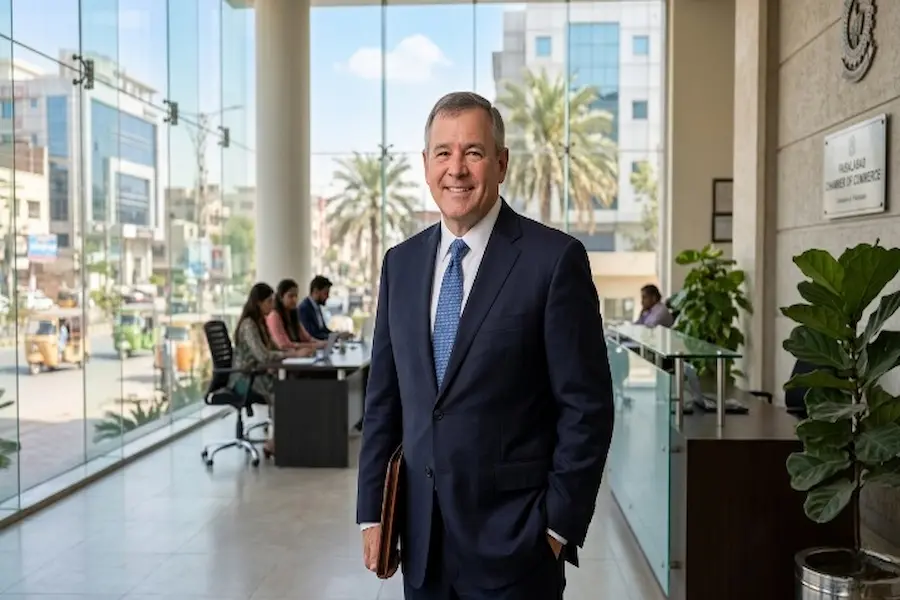
Most people who study business have asked themselves the same question at some point. Does staying patient actually pay off? We live in a world that cheers job-hoppers, fast promotions, and overnight success. So when you hear about someone who spent 37 years at the same company starting by coupling rail cars in all weather and ended up leading commercial operations for one of America’s largest freight railroads, it stops you. Claude Edward Elkins Jr. is that person. He joined Norfolk Southern in 1988 as a road brakeman. He worked through every level of the operation with his hands and then his mind. By December 2021, he was named Executive Vice President and Chief Commercial Officer. His story does not just belong to the railroad world. It belongs to anyone who has ever wondered if the slow, honest path is still worth taking.
This article tells the full story of Ed Elkins: his roots in Southwest Virginia, his military service, his unconventional education, his 37-year climb at Norfolk Southern, and the commercial leadership that now moves freight across 22 states. It is built on verified facts, the official Norfolk Southern biography, Georgia Chamber records, and interviews Elkins gave in his own words. You will not find inflated claims here. What you will find is one of the most grounded, real leadership stories in American business today.
Quick Profile
Here is a verified summary of the key facts before we go deeper.
| Full name | Claude Edward Elkins Jr. |
| Also known as | Ed Elkins |
| Current title | Executive Vice President and Chief Commercial Officer (CCO) |
| Company | Norfolk Southern Corporation |
| Headquarters | 650 W. Peachtree Street NW, Atlanta, Georgia 30308 |
| Career began | 1988 Road Brakeman, Norfolk Southern |
| Years at NS | 37+ years (as of 2026) |
| Military | United States Marine Corps veteran |
| Undergraduate | B.A. in English, University of Virginia’s College at Wise |
| Graduate | MBA, Port & Maritime Economics, Old Dominion University |
| Executive education | Harvard Business School (General Management Program), UVA Darden, University of Tennessee Supply Chain Institute |
| Current home | Buckhead, Atlanta, Georgia (moved from Virginia in 2022) |
| Georgia Chamber | 2025 Chair; Immediate Past Chair as of January 2026 |
| Boards | TTX Company, National Association of Manufacturers, East Lake Foundation, Georgia State University Marketing RoundTable, The Conference Board (Council for CMOs) |
Roots and Upbringing: Southwest Virginia and What It Taught Him
Claude Edward Elkins Jr. grew up in Southwest Virginia. This part of the state sits in the Appalachian mountains. For generations, its economy ran on coal, timber, and freight transport. Rail lines cut through those hills not because it was convenient. They cut through because they had to have communities and industries dependent on them.
Growing up in that environment, Elkins learned something that no classroom teaches. He saw with his own eyes how freight infrastructure shapes real lives. It brings jobs. It moves goods to market. It connects small, remote towns to the rest of the country. That understanding became part of how he thinks long before he ever joined Norfolk Southern.
Southwest Virginia also teaches a particular kind of work ethic. The region is not known for shortcuts. People there value doing a job well, sticking with it, and earning respect through effort. Those are values Elkins carried into every role he held.
His Military Service: U.S. Marine Corps
Before joining the railroad, Claude Edward Elkins Jr. served in the United States Marine Corps.
Military service reshapes how a person thinks and acts. The Marines teach you to lead under pressure. They teach accountability you do not get to explain away a mistake. They teach you to make decisions with incomplete information, because waiting for perfect information is a luxury combat and logistics both deny you.
These habits are not just useful in a war zone. They are exactly what you need in railroad operations. A brakeman makes fast decisions. A yardmaster coordinates chaos. A CCO sets commercial strategy in an industry where one service failure can cost a customer millions.
When Elkins joined Norfolk Southern in 1988 right out of the Marines, the discipline and leadership instincts he brought were already more developed than most people twice his age. That early foundation mattered more than he may have realized at the time.
An Education That Looks Wrong Until You See Why It Was Right
Here is the part of Ed Elkins’ story that surprises most people. He did not study transportation. He did not study engineering or finance. He studied English. Then he earned an MBA focused on ports and maritime shipping. Then he went to Harvard.
On the surface, that path looks like a mismatch. In practice, it built exactly the skill set a commercial executive in freight transportation needs.
B.A. in English University of Virginia’s College at Wise
Elkins earned his undergraduate degree in English from UVA’s College at Wise in Southwest Virginia. It is a small liberal arts school with a strong reputation in the region.
An English degree does something specific. It forces you to read carefully, write clearly, and argue a position. It makes you understand how other people think because you spend years reading what people across history and culture have said and why. In a commercial leadership role, that skill is worth more than most technical degrees.
Think about what the CCO role actually requires. You negotiate with large shipping customers. You present a commercial strategy to a board. You align marketing, sales, and operations teams that do not naturally speak the same language. You need to translate between the field team that thinks in schedules and the finance team that thinks in margins. None of that works without communication skills and those are exactly what an English degree builds.
| “Elkins’ English degree gave him something most logistics executives lack: the ability to frame a complex situation in plain language that both a truck driver and a board director can understand.” Content analysis based on verified career record |
MBA in Port and Maritime Economics Old Dominion University
After years of building operational experience at Norfolk Southern, Elkins went back to school. He earned an MBA from Old Dominion University with a specialization in Port and Maritime Economics.
ODU is based in Norfolk, Virginia, one of the busiest port cities in the United States. Their maritime economics program is practical and specific. It does not teach generic business theory. It teaches how freight moves through ports, how shipping economics work, and how rail, sea, and truck logistics connect into a single global supply chain.
This degree changed how Elkins saw his job. Before, he understood the railroad as a system. Afterwards, he understood it as one piece of a much larger puzzle and he saw how to make that piece fit better for customers who needed end-to-end freight solutions.
That insight directly shaped his 20 years in intermodal marketing, where his job was exactly that: connecting rail with trucking, shipping, and port logistics to give customers a seamless freight experience.
Executive Education: Harvard, UVA Darden, and University of Tennessee
Elkins did not stop investing in his education after his MBA. Over the course of his career, he completed executive programs at three highly respected institutions.
• Harvard Business School: General Management Program
• UVA Darden School of Business: executive leadership development
• University of Tennessee Supply Chain Institute: supply chain strategy
Each one added a specific layer. Harvard sharpened his general management thinking. Darden refined his leadership approach. Tennessee deepened his supply chain knowledge at a time when supply chains were becoming the central concern of global commerce.
Taken together, his education follows a clear pattern. He never stopped learning. He identified gaps in his knowledge and filled them with discipline not with shortcuts.
The Career: 37 Years, One Company, Every Level
Claude Edward Elkins Jr. has spent his entire professional career at Norfolk Southern. That is one of the rarest facts in modern American business. And it was not passive. It was a strategy the same company offered a complete education in the freight rail business from the ground up.
Here is how his career progressed, role by role.
| Year | Role / Milestone |
| 1988 | Joined Norfolk Southern as a Road Brakeman after U.S. Marine Corps service |
| Late 1980s–90s | Progressed to Conductor and Locomotive Engineer mastering hands-on rail operations |
| Mid 1990s | Served as Relief Yardmaster coordinating rail yard logistics, scheduling, and safety |
| Late 1990s–2016 | Spent nearly two decades in Intermodal Marketing connecting rail with trucking, ports, and global freight |
| 2016 | Named Group Vice President of Chemicals Marketing |
| 2018 | Promoted to Vice President of Industrial Products |
| December 2021 | Named Executive Vice President and Chief Commercial Officer, Norfolk Southern Corporation |
| 2023 | Appointed Georgia Chamber of Commerce Foundation Chair |
| 2024 | Served as Georgia Chamber Vice Chair |
| January 2025 | Became 2025 Chair of the Georgia Chamber first railroad executive in over 100 years to hold this role |
| January 2026 | Completed term as Chair; named Immediate Past Chair. Stuart Countess (Kia Georgia) succeeded him. |
Starting at the Bottom: Road Brakeman (1988)
A road brakeman is one of the most physically demanding and genuinely dangerous jobs in railroading. You couple and uncouple rail cars. You operate track switches. You work outdoors in every kind of weather summer heat, winter cold, rain, fog. Safety is not a priority. It is the job.
Elkins started here. He was not placed in a management training program. He was placed on the tracks, learning the railroad the way every great railroad leader learns it by doing the actual work.
This is the fact that separates him from almost every executive in the freight industry. When he later sat across the table from a customer and described what Norfolk Southern could deliver, he was not working from a slide deck. He knew what the railroad could do because he had done it himself.
Two Decades in Intermodal Marketing
After mastering field operations, Elkins moved into intermodal marketing. He stayed there for nearly 20 years.
Intermodal freight means moving cargo using more than one mode of transport typically rail combined with truck, and sometimes ship. A product might leave a factory on a truck, transfer to a rail container in Memphis, ride a train to a port in Savannah, and load onto a ship headed for Europe. Each handoff has to be seamless for the customer.
Elkins’ background gave him a specific advantage in this role. He knew how the railroad actually operated, which meant he could design freight solutions that were ambitious but achievable. He could promise customers service levels he knew the railroad could deliver because he had stood on those tracks himself.
This period built his commercial instincts. He learned how to listen to customers, understand their supply chain pressures, and design rail solutions that competed effectively with trucking on price, reliability, and environmental impact.
Group Vice President of Chemicals Marketing (2016)
Chemical freight is one of the most regulated segments in rail. It requires deep knowledge of safety protocols, hazardous material handling, and compliance requirements. Moving chemicals by rail demands precision and the consequences of errors are severe.
Elkins’ appointment as Group VP of Chemicals Marketing was a signal from the company. His skill set had moved beyond intermodal. He could manage complexity in any freight category.
Vice President of Industrial Products (2018)
Industrial products include metals, construction materials, and forest products. These are the physical inputs of the American economy steel beams, lumber, and raw materials that build buildings, manufacture cars, and supply factories.
By 2018, Elkins had managed rail operations, intermodal logistics, chemical freight, and now industrial supply chains. He understood the railroad from multiple angles which is exactly what the CCO role would require.
Executive Vice President and Chief Commercial Officer (December 2021)
In December 2021, Claude Edward Elkins Jr. was named Executive Vice President and Chief Commercial Officer. This is the top commercial role at Norfolk Southern.
The business units under his leadership include:
• Intermodal: the company’s largest and most competitive freight segment
• Automotive: Norfolk Southern moves more automotive traffic than any other Class I railroad
• Industrial Products: metals, construction materials, forest products
• Real Estate and Industrial Development
• First and Final Mile Markets
• Field Sales and Customer Logistics
His job is to grow revenue, keep customers committed to rail, and make sure Norfolk Southern competes effectively against trucking, other rail carriers, and emerging logistics competitors.
What Ed Elkins Actually Does as CCO of Norfolk Southern
Norfolk Southern has operated since 1827 nearly 200 years of moving goods across the eastern United States. Here is the scale of the company that Elkins now leads commercially.
| Norfolk Southern at a glance (verified, 2025–2026) •Delivers more than 7 million carloads annually • Connects to more than 54 inland, lake, river, and sea ports • Operates in 22 states across the eastern United States • Helps customers avoid approximately 15 million tons of carbon emissions each year by choosing rail over truck • Operates the most extensive intermodal network in the eastern US • Originates more automotive traffic than any other Class I Railroad • In Georgia alone: 1,706 miles of track, 4,069 employees, 1,263 unique customers served • NS invested over $1 billion in Georgia in recent years, including $200M annually in infrastructure |
As CCO, Elkins is responsible for all of the commercial activity that drives those numbers. That means:
•Setting pricing strategy across all freight segments and markets
•Building and defending customer relationships with major industrial and retail shippers
•Growing market share against competing freight carriers and long-haul trucking
•Aligning sales, marketing, and customer logistics teams around a single commercial strategy
•Representing Norfolk Southern in industry and policy discussions
Technology and Innovation Under His Leadership
One of the most important parts of Elkins’ commercial role is helping modernize a 200-year-old industry. He has championed several technology initiatives that directly improve service reliability which is the commercial message rail needs to win business from trucking.
•AI-powered track inspection: Norfolk Southern now uses artificial intelligence to identify track problems before they cause service failures. This improves safety and on-time performance.
•Real-time shipment tracking: Customers can see where their freight is at any moment. In 2024, Elkins launched a Customer Advisory Board to formalize the process of listening to shippers and acting on their input.
•Predictive maintenance: Data analytics now help maintenance crews fix equipment before it breaks down, reducing unplanned delays.
| “Our commitment to being a trusted transportation partner for our customers drives everything we do.”Claude Edward Elkins Jr. on launching Norfolk Southern’s Customer Advisory Board, 2024 |
Rail vs. Trucking: Why Claude Edward Elkins Jr Commercial Case Matters
Elkins has made a consistent argument throughout his tenure as CCO. Rail is not just cheaper than trucking for heavy freight. It is also greener, safer, and more efficient at scale. Here is how the comparison looks:
| Category | Rail (Norfolk Southern) | Long-Haul Trucking |
| Fuel efficiency per ton-mile | 3 to 4x more efficient | Lower efficiency, higher fuel use |
| Carbon emissions | ~75% lower per ton-mile | Higher emissions per unit |
| Network capacity | 54+ port connections, 22 states | Road-dependent, more congestion-prone |
| Cost for heavy freight | Lower at scale | Higher for bulk/long-distance |
| Reliability (NS target) | Improving 40% accident reduction cited (2025) | Varies by carrier |
Source: Norfolk Southern Corporation data; comparative figures reflect industry averages for Class I rail vs. long-haul trucking.
How Ed Elkins Leads: What 37 Years Actually Produces
There is a type of executive that learns leadership from books and frameworks. And there is a type that learns it by doing hard work, making real mistakes, and watching what actually moves people. Ed Elkins is the second type.
His leadership style has a specific texture. It is grounded. It is patient. And it is built on something most executives cannot claim: he has done the work at every level of the organization he now leads commercially.
Read This: Peter Buchignani Net Worth, Age, Career & Family Life
Credibility With the People Who Do the Work
When Elkins walks through a rail yard or talks with a conductor about a service problem, he is not visiting a foreign country. He was that conductor. He was that brakeman. He worked 12-hour shifts in rough weather. He understands what those jobs actually cost the people doing them.
That credibility is not something you can learn from a management program. It has to be earned and Elkins earned it across decades of actual work.
The Long Game Mindset
In a 2025 interview with the Saporta Report, Ed Elkins said something that cuts through a lot of leadership noise. Reflecting on his 36 years at Norfolk Southern, he said:
| “I’ve been here 36 years, and 32 of those years were pretty boring.”Claude Edward Elkins Jr. Saporta Report |
That line tells you everything about how he thinks. He was not chasing exciting assignments or headline-grabbing moves. He was doing the work, year after year, getting better at it. The result of 32 boring years was the credibility and expertise that made the last four years possible when he became CCO during one of the most turbulent periods in Norfolk Southern’s recent history.
Safety as a Commercial Strategy, Not Just a Policy
In rail, safety failures cost money. An accident delays trains, disrupts customer shipments, damages equipment, and creates regulatory scrutiny. Elkins has consistently connected safety performance to commercial performance because they are the same thing.
At the 2025 North American Rail Shippers meeting, he highlighted that Norfolk Southern had achieved a 40% reduction in mainline accidents. He credited planning and technology investment. For commercial customers evaluating whether to commit freight to rail, that number matters. A safer railroad is a more reliable railroad. And a more reliable railroad is easier to choose over trucking.
Listening Before Leading
The Customer Advisory Board that Elkins launched in late 2024 is a good example of how he operates. Instead of deciding what customers want, he built a formal structure to ask them and then act on what he heard.
This is the same discipline he used as a brakeman learning from experienced conductors. He observed, asked questions, and then applied what he learned. The approach scaled from the rail yard to the boardroom without changing its essential character.
Beyond Norfolk Southern: The Georgia Chamber and Community Leadership
Ed Elkins’ influence extends well beyond Norfolk Southern’s commercial results. Since Norfolk Southern moved its headquarters to Atlanta in 2022 and since Elkins moved his family to Buckhead he has become one of Georgia’s most prominent business voices.
Georgia Chamber of Commerce A Full Picture
His progression through the Georgia Chamber is worth laying out clearly, because most articles get this wrong.
| Year | Role / Milestone |
| 2023 | Appointed Foundation Chair, Georgia Chamber of Commerce Executive Committee |
| 2024 | Served as Vice Chair, Georgia Chamber of Commerce |
| January 2025 | Became 2025 Chair of the Georgia Chamber first railroad executive to hold this role in over 100 years. He addressed more than 2,600 leaders at the annual Eggs & Issues legislative breakfast. |
| January 2026 | Completed his term. Named Immediate Past Chair. Stuart Countess (President & CEO, Kia Georgia) became 2026 Chair. |
In his acceptance as Chair in January 2025, Elkins said:
| “It’s an honor to serve as Chair of the Georgia Chamber, building on the strong foundation laid by Pedro Cherry, Chris Clark, and past leaders. Georgia’s business community shares a commitment to growth. As a representative of Norfolk Southern, a railroad that powers the nation’s supply chain from right here in Georgia, I’m especially proud to contribute to this mission and amplify the interests of Georgia businesses big and small.”Claude Edward Elkins Jr. Georgia Chamber Chair acceptance, |
When he handed the gavel to Stuart Countess in January 2026, Elkins reflected on what his year as Chair achieved. He highlighted tort reform as a major win one that is already showing signs of stabilizing insurance rates in Georgia. He also pointed to Norfolk Southern’s $1 billion investment in the state and reaffirmed the railroad’s long-term commitment to Georgia, noting that “Norfolk Southern and our predecessor railroads have operated in Georgia for nearly 200 years.’
He also addressed a concern at the 2026 Eggs & Issues event that Georgia would remain what he called ‘the Eastern gateway for a unified rail corridor’ reinforcing freight infrastructure as a core part of the state’s economic future.
Board Memberships and External Roles
| TTX Company | Board of Directors TTX coordinates railcar sharing across North American Class I railroads |
| National Association of Manufacturers (NAM) | Board member advocates for American manufacturing and industrial freight policy |
| East Lake Foundation | Board member community revitalization and youth development in Atlanta |
| Georgia State University | Marketing RoundTable member connects business and academic talent in marketing and logistics |
| The Conference Board | Member, Council for CMOs connects commercial leaders across major US industries |
| Traffic Club of Chicago | Active member |
| Traffic Club of New York | Active member |
| Traffic Club of Pittsburgh | Active member |
Community Work: East Lake Foundation
Through the East Lake Foundation in Atlanta, Elkins is connected to one of the most recognized community revitalization efforts in the Southeast. The foundation focuses on breaking cycles of poverty through education, health programs, and economic opportunity.
For Elkins, this work connects to the values he grew up with in Southwest Virginia a region that has often been overlooked by the broader American economy, much like the Atlanta neighborhoods the East Lake Foundation serves.
5 Lessons From Claude Edward Elkins Jr.’s Career
You do not need to work in freight rail to apply what Ed Elkins has demonstrated. His career offers clear lessons for anyone building a professional life in any industry.
•Lesson 1: Master the job you have not the job you want. Elkins started as a brakeman. He did not treat it as a waiting room. He learned it completely. That depth opened the next door, and the door after that.
•Lesson 2: Study what sharpens your weakest skill, not your strongest. He was already operationally capable. He chose English which built communication and then maritime economics which built strategic context. Both choices addressed gaps, not strengths.
•Lesson 3: Loyalty, done right, is a competitive advantage. 37 years at one company sounds limiting. But it gave him knowledge, relationships, and credibility that no resume-hopper can build. In industries built on trust and institutional knowledge, depth beats breadth.
•Lesson 4: Boring years are not wasted years. As he said himself, 32 of his 36 years felt ‘pretty boring.’ But those years were where the expertise was built. The four dramatic years at the top were only possible because of the 32 quiet ones before them.
•Lesson 5: Community leadership multiplies your professional influence. His Georgia Chamber work was not separate from his business role. It directly expanded his network, increased Norfolk Southern’s visibility in the state, and gave him a platform to advocate for freight infrastructure at the policy level.
Quick Reference Takeaways
For readers who want the key facts in one place.
| Topic | Key Fact |
| Career span | 37+ years at one company Norfolk Southern (1988–present) |
| Starting role | Road Brakeman one of the most physically demanding entry-level rail jobs |
| Education path | English B.A. → Maritime MBA → Harvard, Darden, Tennessee (exec programs) |
| CCO appointment | December 2021 |
| Georgia Chamber | 2025 Chair; Immediate Past Chair from January 2026 |
| Historic distinction | First railroad executive to chair Georgia Chamber in 100+ years |
| Real quote | “32 of those 36 years were pretty boring” on building expertise slowly |
| NS scale | 7M+ carloads, 54+ ports, 22 states, 15M tons CO2 avoided/year |
| NS in Georgia | $1B+ invested; 1,706 track miles; 4,069 employees; 1,263 customers |
| Common error to avoid | He is NOT the fourth-generation railroader. That is John Orr (COO). |
Also Read: The Heart of Community: Discovering Mary Beougher’s Contributions
FAQs
Who is Claude Edward Elkins Jr.?
Claude Edward Elkins Jr. known as Ed Elkins is the Executive Vice President and Chief Commercial Officer of Norfolk Southern Corporation. He began his career as a road brakeman at Norfolk Southern in 1988, after serving in the U.S. Marine Corps, and worked his way to the top commercial role over 37 years.
What does Ed Elkins do at Norfolk Southern?
As CCO, he leads Norfolk Southern’s commercial operations including Intermodal, Automotive, and Industrial Products freight, plus Real Estate, Industrial Development, First and Final Mile Markets, Field Sales, and Customer Logistics. He is responsible for revenue growth, customer relationships, and commercial strategy across 22 states.
What is Claude Edward Elkins Jr.’s educational background?
He holds a B.A. in English from the University of Virginia’s College at Wise and an MBA in Port and Maritime Economics from Old Dominion University. He also completed executive education at Harvard Business School (General Management Program), UVA Darden School of Business, and the University of Tennessee Supply Chain Institute.
Did Claude Edward Elkins Jr. serve in the military?
Yes. Before joining Norfolk Southern in 1988, he served in the United States Marine Corps. His military background shaped his leadership approach and his ability to operate effectively under pressure.
When was Ed Elkins appointed Chief Commercial Officer?
He was appointed Executive Vice President and Chief Commercial Officer of Norfolk Southern Corporation in December 2021.
What is Ed Elkins’ role at the Georgia Chamber of Commerce in 2026?
As of January 2026, Ed Elkins is the Immediate Past Chair of the Georgia Chamber of Commerce. He served as 2025 Chair the first railroad executive in over 100 years to lead the organization. Stuart Countess (KIA Georgia) became the 2026 Chair.
Is Claude Edward Elkins Jr. a fourth-generation railroader?
No, this is a factual error that appears in several competitor articles. The fourth generation railroader at Norfolk Southern is COO John Orr, per the official NS leadership biography and Railway Age magazine (January 2026). Elkins’ official NS biography does not use this description.
What boards does Claude Edward Elkins Jr. sit on?
He serves on the boards of TTX Company, the National Association of Manufacturers, and the East Lake Foundation. He is also a member of the Georgia State University Marketing RoundTable and The Conference Board’s Council for CMOs.
Is Ed Elkins still at Norfolk Southern in 2026?
Yes. As of April 2026, Claude Edward Elkins Jr. continues to serve as Executive Vice President and Chief Commercial Officer at Norfolk Southern Corporation.
Where does Ed Elkins live?
He lives in Buckhead, Atlanta, Georgia. He relocated from Virginia in 2022 when Norfolk Southern consolidated its headquarters at 650 W. Peachtree Street NW in Atlanta.
What is Norfolk Southern’s scale under Elkins’ commercial leadership?
Norfolk Southern delivers more than 7 million carloads annually, connects to more than 54 ports, operates in 22 states, and helps customers avoid approximately 15 million tons of carbon emissions each year by choosing rail over truck.
Conclusion
There is something almost unfashionable about the way Claude Edward Elkins Jr. built his career. He did not pivot. He did not personal-brand his way into the executive suite. He did not leave for a better offer every three years. He showed up, in all weather, and did the work. First with his hands on the tracks. Then with his mind in marketing. Then with his voice at the Georgia Chamber podium. When he said that 32 of his 36 years at Norfolk Southern felt ‘pretty boring,’ he was not complaining.
He was describing the honest reality of building real expertise and he said it with the quiet confidence of someone who knows exactly what those boring years produced. The freight that moves across 22 states. The commercial strategy that connects 54 ports. The customer relationships built over two decades in intermodal marketing. None of that comes from shortcuts. All of it comes from showing up, year after year, and getting better at something that matters.
This is what a life of purpose looks like when you strip away the noise. Not a highlight reel. A full career, with its slow years and its dramatic ones, its routine roles and its historic appointments, its Southwest Virginia roots and its Atlanta boardrooms. The title of this article is a life of purpose and after 37 years at one company, two degrees, three executive programs, a Marine Corps deployment, a historic Chamber chairmanship, and countless freight decisions that kept American supply chains moving, the case makes itself. Ed Elkins earned every word of it.
